September 16, 2026
demo

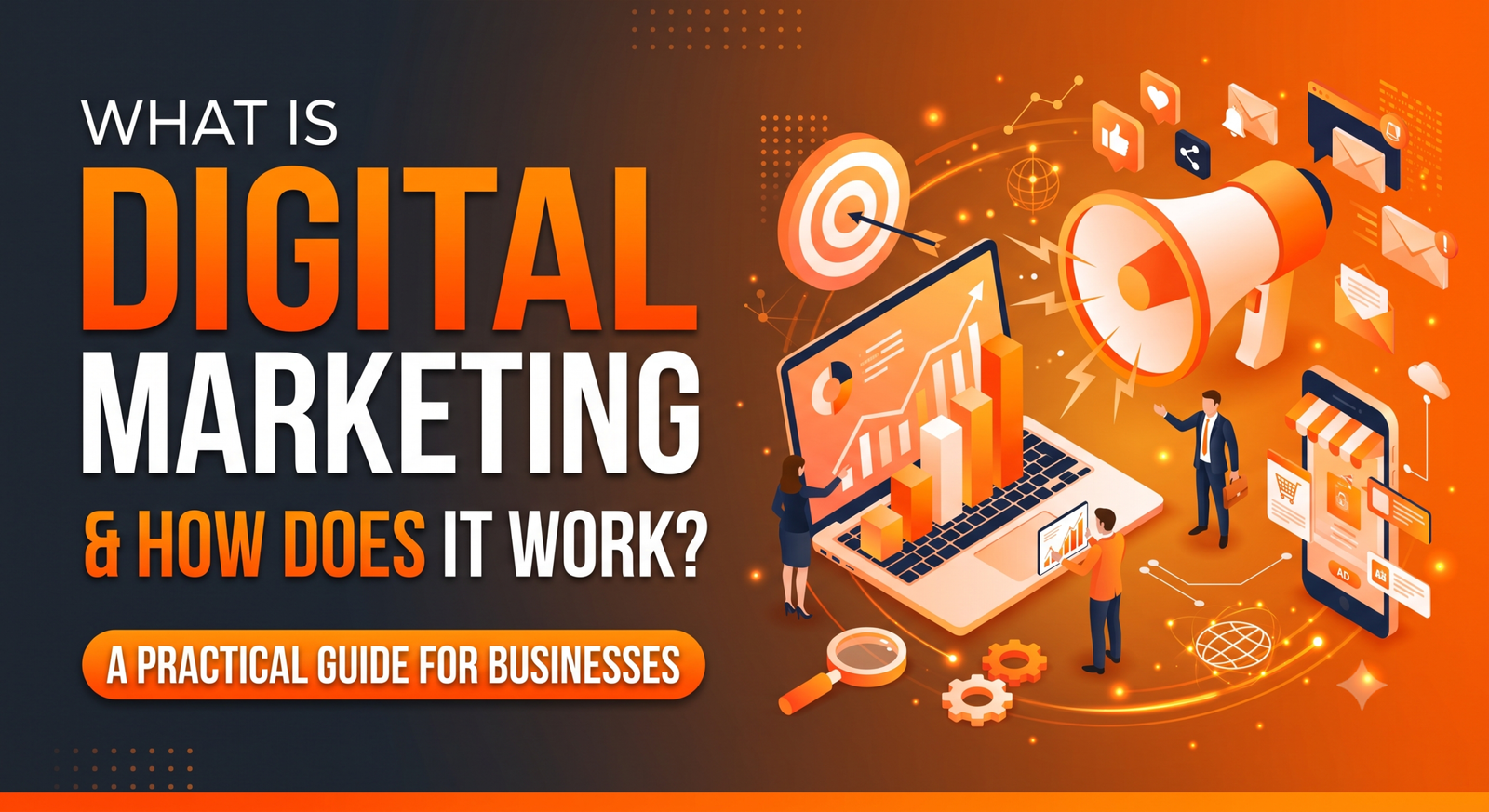
Digital marketing is often described as “marketing through the internet.” That definition is technically correct, but it misses the bigger picture.
For a modern business, digital marketing is a connected system that helps people discover a brand, understand its value, trust it, contact it, buy from it, and eventually return to it.
A business might use Google Search to attract someone who is already looking for a product. Social media can introduce the same person to the brand earlier in their buying journey. A well-designed website can turn that interest into a lead, while email, remarketing, content and customer communication can help convert that lead into a customer.
In other words, digital marketing is not one activity. It is a combination of channels working toward a common business objective.
This guide explains what digital marketing is, how it works, which channels are involved, how businesses measure results, and how the growth of AI-powered search is changing the digital marketing landscape.
Digital marketing is the process of promoting a business, product, service or brand through digital channels and technologies.
These channels can include:
The important part is not simply being present on these platforms.
The real purpose is to connect the right message with the right person at the right stage of their decision-making process.
For example, imagine someone searching Google for “SEO agency in Delhi.”
That person is already showing commercial intent.
If a company has a well-optimized service page, useful supporting content, a strong Google Business Profile and credible online presence, it has multiple opportunities to become visible to that potential customer.
Now consider someone watching an Instagram video about “How to get more customers from Google.”
That person may not be ready to hire an agency today, but the content can introduce the brand and create future demand.
Both activities are digital marketing, but they serve different purposes.
Digital marketing generally works through a journey rather than a single interaction.
A simplified customer journey looks like this:
Attention → Discovery → Interest → Trust → Conversion → Retention → Recommendation
Let’s break it down.
First, a business needs to get noticed.
This could happen through:
At this stage, the objective is visibility.
Once someone notices a business, they may search for more information.
For example:
“Digital marketing company Delhi”
or:
“Best SEO services for small business”
The user may visit a website, Google Business Profile, social media profile or third-party review platform.
This is where a consistent digital presence becomes important.
Visibility alone does not create customers.
The visitor needs a reason to continue.
Useful content, clear services, case studies, reviews, demonstrations, pricing information and educational resources can help answer the visitor’s questions.
A good digital marketing strategy therefore focuses not only on attracting traffic but also on giving visitors useful reasons to stay.
Before spending money, people often investigate a company.
They may look for:
This is why digital marketing is also a trust-building activity.
A conversion occurs when a visitor takes a desired action.
Depending on the business, that could mean:
The conversion does not necessarily have to be a sale.
For a service company, generating a qualified lead may be the primary conversion.
Digital marketing does not necessarily stop after someone becomes a customer.
Businesses can use:
to maintain relationships with existing customers.
Satisfied customers can become another source of growth.
They may:
This creates a cycle where customers can contribute to future visibility.
Digital marketing includes several specialized areas. The most effective strategy often combines multiple channels instead of depending on only one.
SEO is the process of improving a website and its online presence so that relevant pages can appear more prominently in organic search results.
SEO can involve:
For example, a web development company may create useful pages targeting searches related to:
The objective is not simply to attract visitors.
The objective is to attract relevant visitors who have a genuine connection with the company’s services.
PPC advertising allows businesses to pay for visibility on advertising platforms.
Google Ads is one of the most widely used examples.
Suppose someone searches:
“web development company near me”
A relevant business can use paid advertising to appear prominently for that search.
The advantage of PPC is speed.
SEO may require time to build visibility, whereas paid campaigns can begin generating impressions and clicks soon after launch.
However, PPC requires careful management.
Businesses need to monitor:
Getting clicks is not the same thing as getting profitable customers.
Social media marketing uses platforms such as Instagram, Facebook, LinkedIn and other social networks to build awareness, engagement and business opportunities.
Social media can be used for:
For example, an interior design company could publish before-and-after projects, while an IT company could explain common cybersecurity or networking problems.
The strongest social content usually gives people a reason to stop scrolling.
Content marketing focuses on creating useful information for a specific audience.
Content can include:
A useful way to think about content marketing is:
Answer the questions your potential customers ask before they contact you.
If people repeatedly ask:
“How much does SEO cost?”
that question can become an educational article.
If customers ask:
“How long does SEO take?”
that can become another article, video or FAQ.
Over time, this creates a library of information that can support both search visibility and customer education.
Email marketing allows businesses to communicate directly with people who have opted into their communications.
It can be used for:
For businesses with longer sales cycles, email can help maintain communication between the first interaction and the eventual purchase.
Local SEO is particularly important for businesses serving a specific geographic area.
A local customer might search:
“digital marketing agency in Delhi”
or:
“hair transplant clinic near me”
or:
“best dentist in Noida”
Local SEO can involve:
For businesses that depend on customers visiting a location or serving a particular service area, local search visibility can be a significant part of digital marketing.
A business can have excellent traffic and still generate very few leads.
Why?
Because traffic and conversion are two different problems.
A website should make it easy for visitors to understand:
Conversion optimization may involve improving:
The goal is to reduce unnecessary friction between interest and action.
Performance marketing focuses heavily on measurable actions and outcomes.
Depending on the campaign, businesses may track:
Instead of asking only:
“How many people saw our advertisement?”
a performance-focused marketer also asks:
“What happened after those people saw it?”
That difference is important because visibility is only one part of business growth.
Traditional marketing can include:
Digital marketing uses digital environments such as:
One important difference is measurement.
Digital campaigns can often provide detailed information about interactions such as clicks, visits, conversions and campaign costs.
Traditional marketing can also be measured, but measurement methods and attribution can be different depending on the medium.
Businesses do not necessarily have to choose one exclusively. Depending on the audience and business model, digital and traditional channels can work together.
Imagine a company that provides website development services.
Its potential customer journey might look like this:
Step 1: A business owner searches Google for website development.
Step 2: They discover the company’s service page through organic search or an advertisement.
Step 3: They read the service information and visit a case study.
Step 4: They check reviews and the company’s social profiles.
Step 5: They compare the company with other providers.
Step 6: They submit a consultation form.
Step 7: The sales team contacts them.
Step 8: The prospect becomes a customer.
In this example, SEO, PPC, website design, content, reputation and conversion optimization are not separate islands.
They are different parts of the same customer journey.
Search is becoming more conversational.
People increasingly ask AI-powered systems questions rather than relying exclusively on traditional keyword searches.
Examples include:
This creates a new consideration for businesses:
Can people discover and understand my brand when they ask AI systems for recommendations or information?
This area is often discussed using terms such as:
Traditional SEO remains important, but businesses are increasingly thinking about how their content, expertise, entities, reputation and information structure can make their brand understandable to both search engines and AI systems.
A useful approach is not to create content solely for an algorithm.
Instead, businesses should build content that clearly demonstrates:
The goal is to make the business easier to understand across the digital ecosystem.
These channels can perform different jobs.
| Channel | Primary Purpose | Typical Strength |
|---|---|---|
| SEO | Organic visibility | Long-term search discovery |
| PPC | Paid visibility | Faster traffic and lead generation |
| Social Media | Awareness and engagement | Brand/community building |
| Content Marketing | Education | Trust and topical authority |
| Email Marketing | Relationship building | Retention and nurturing |
| Local SEO | Local discovery | Location-based customers |
| Website CRO | Conversion | Turning visitors into leads/customers |
The channels should not necessarily compete with one another.
A business may use SEO to capture existing demand, social media to create awareness, PPC to target high-intent searches, and email to nurture leads.
A digital marketing strategy should start with the business rather than with a random list of platforms.
Ask:
Identify:
Not everyone searching for a topic wants to buy something.
For example:
“What is SEO?”
is primarily informational.
“SEO agency pricing”
has stronger commercial intent.
“Hire SEO agency Delhi”
has a much stronger transactional direction.
Understanding this difference helps businesses create the appropriate content and campaigns.
A business does not need to be everywhere.
Choose channels based on where potential customers actually discover and evaluate businesses.
For some businesses, SEO and Google Ads may be central.
For others, Instagram, YouTube or LinkedIn may play a larger role.
These could include:
Track metrics that connect marketing activity to business outcomes.
Important metrics can include:
There is no universal timeline.
Different channels behave differently.
Paid advertising can produce traffic quickly, while SEO generally requires time to establish visibility.
Results can also depend on:
A business should therefore avoid judging an entire strategy using only a few days of data.
A better approach is to establish measurable goals and evaluate progress consistently.
Thousands of irrelevant visitors may be less valuable than a smaller number of highly relevant prospects.
Being active everywhere does not automatically create results.
A large number of articles does not guarantee useful traffic.
Marketing can bring visitors, but the website has to help those visitors take the next step.
Followers and impressions can be useful indicators, but businesses ultimately need to understand how marketing contributes to meaningful outcomes.
Organic visibility usually requires consistent work and time.
Different audiences can have different needs, objections and buying journeys.
There is no single digital marketing price that applies to every business.
Costs can vary depending on:
For example, a local business focusing on Google Business Profile and local SEO may have very different requirements from a national e-commerce company running SEO, Google Ads, social media and content campaigns.
Instead of asking only:
“How much does digital marketing cost?”
businesses should also ask:
“What business outcome are we trying to achieve, and what level of marketing investment is appropriate for that goal?”
A good reporting system connects marketing metrics with business objectives.
For example:
SEO
PPC
Social Media
Website
The most useful question is not simply:
“How much traffic did we get?”
It is:
“Did our digital marketing move the business closer to its goal?”
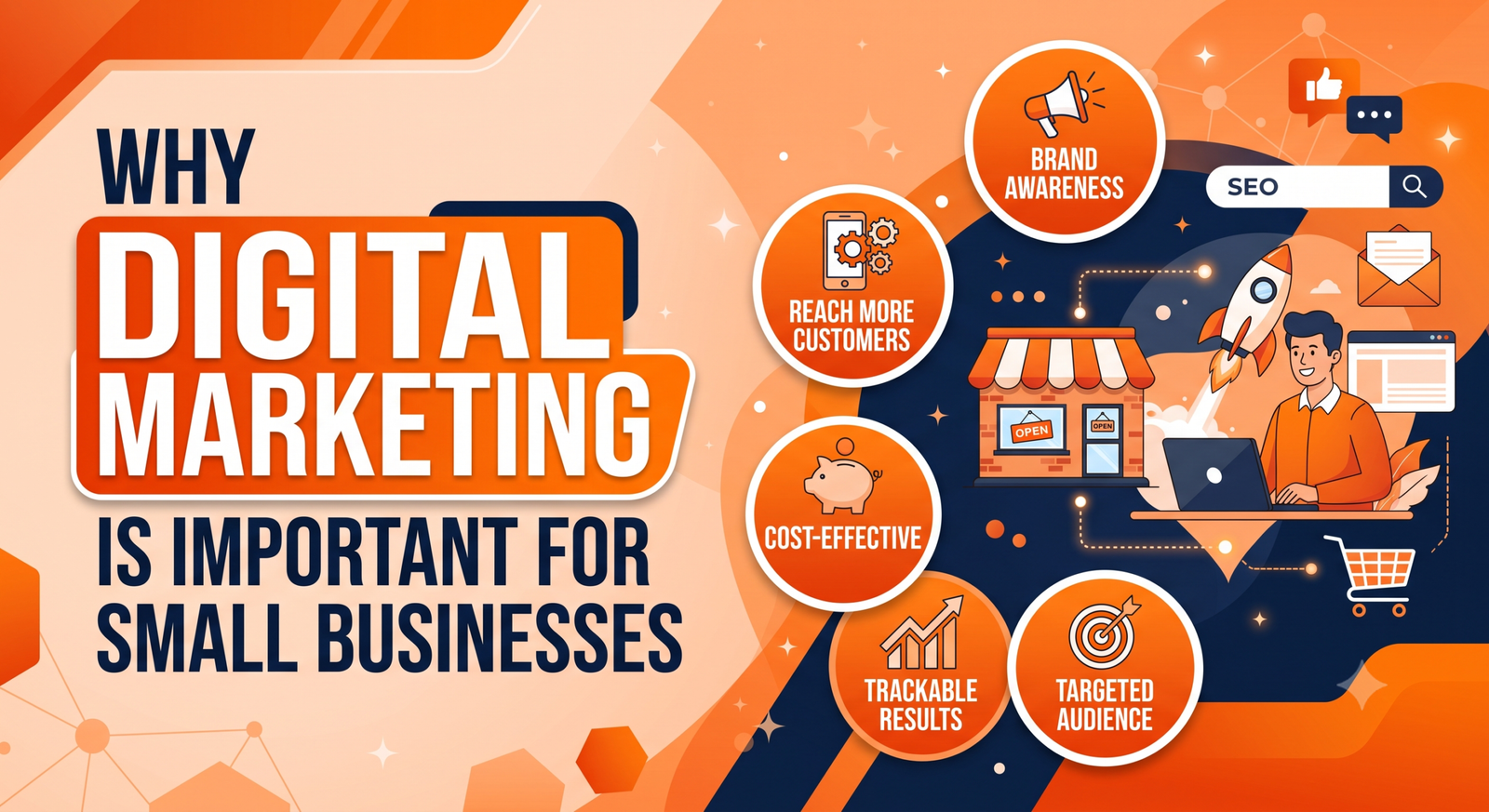
Small businesses often have limited resources.
Digital marketing can give them ways to compete for attention without relying exclusively on large traditional advertising campaigns.
A small business can build visibility through:
The strategy should be focused rather than scattered.
Instead of trying to dominate every channel, a small business can identify where its customers are most likely to search, compare and make decisions.
Digital marketing is moving from a simple “website + social media + advertising” model toward a more connected digital ecosystem.
Businesses increasingly need to think about:
One major change is that customers can encounter a business in many different places before contacting it.
Someone might first see a social post, later search Google, read a blog, check reviews, ask an AI tool for information, visit the website and finally contact the company.
This means digital marketing is becoming less about managing isolated channels and more about creating a consistent, trustworthy and useful digital presence.
Digital marketing is not simply about posting on social media or ranking a website on Google.
It is a system for connecting businesses with people throughout the customer journey.
SEO can help people discover a business.
PPC can put an offer in front of high-intent audiences.
Social media can build awareness.
Content can answer questions.
A website can turn attention into action.
Email can nurture relationships.
Local SEO can help businesses become visible to nearby customers.
And emerging AI search platforms are creating another layer of digital discovery.
The businesses that approach digital marketing as a connected system—not as a collection of unrelated tasks—can make better decisions about where to invest their time and resources.
Previous Story
demo
demo
WhatsApp us